





It's in our... hands to stop hurting!
 Image credit: unsplash.com[/caption]
These movements are simple, require no special thought, and are considered almost self-evident for us until that moment when we feel an annoying pain in our wrist, which often radiates to the shoulder, preventing us from doing our basic habits, such as simply lifting our coffee cup, brushing our teeth, or buttoning our shirt!
[caption id="attachment_3180" align="aligncenter" width="234"]
Image credit: unsplash.com[/caption]
These movements are simple, require no special thought, and are considered almost self-evident for us until that moment when we feel an annoying pain in our wrist, which often radiates to the shoulder, preventing us from doing our basic habits, such as simply lifting our coffee cup, brushing our teeth, or buttoning our shirt!
[caption id="attachment_3180" align="aligncenter" width="234"] Image credit: unsplash.com[/caption]
The wrist alone consists of eight bones surrounding it, four at the top and four at the bottom. All eight bones are connected by ligaments that hold the joints together, allowing a wide range of motion in our hands. There are also many tendons that pass through the wrist. These control the movement of the wrist, fingers, and thumb. Because each of these parts serves a specific movement, even if only a small area becomes irritated, we will immediately feel it.
Image credit: unsplash.com[/caption]
The wrist alone consists of eight bones surrounding it, four at the top and four at the bottom. All eight bones are connected by ligaments that hold the joints together, allowing a wide range of motion in our hands. There are also many tendons that pass through the wrist. These control the movement of the wrist, fingers, and thumb. Because each of these parts serves a specific movement, even if only a small area becomes irritated, we will immediately feel it.
But what is this strain that develops into pain in our hand?
The repetitive use of a specific muscle group sometimes leads to so-called "overuse syndromes" with specific symptoms. Let's look at these in more detail.- [big]Carpal Tunnel Syndrome[/big]
 Carpal Tunnel Syndrome (CTS) is considered one of the diseases of the 21st century, as the evolution of new technologies, in particular, has introduced this intensive use of our hand, which now acts as an extension of the smartphone, tablet, and mouse, or in our free time, our favorite gaming console.
The syndrome is caused when the median nerve, which passes through a narrow passage in the wrist, the "carpal tunnel," is severely compressed by continuous use.
Carpal tunnel is mainly considered an occupational injury and tends to occur more frequently in women.
Carpal tunnel usually begins with an undefined sensation of heaviness in the wrist. This heaviness develops into numbness in the fingers and stiffness (especially in the thumb, index, and middle finger), sluggishness and inability to grasp an object, a sensation of heat, and of course pain that sometimes extends to the shoulder.
Carpal Tunnel Syndrome (CTS) is considered one of the diseases of the 21st century, as the evolution of new technologies, in particular, has introduced this intensive use of our hand, which now acts as an extension of the smartphone, tablet, and mouse, or in our free time, our favorite gaming console.
The syndrome is caused when the median nerve, which passes through a narrow passage in the wrist, the "carpal tunnel," is severely compressed by continuous use.
Carpal tunnel is mainly considered an occupational injury and tends to occur more frequently in women.
Carpal tunnel usually begins with an undefined sensation of heaviness in the wrist. This heaviness develops into numbness in the fingers and stiffness (especially in the thumb, index, and middle finger), sluggishness and inability to grasp an object, a sensation of heat, and of course pain that sometimes extends to the shoulder.
- [big]Tendonitis[/big]
Tendonitis in our wrist, fingers, or thumb similarly appears when a muscle group is overstrained by a daily, repetitive movement.
Tendons are elastic structures that connect muscles to bones, transferring movement to our joints, while their size and
shape varies; for example, the tendons in our wrist are larger than those in our fingers.
When the tendon becomes inflamed, causing a painful sensation, we are talking about tendonitis.
The main symptoms are tenderness to palpation, pain during movement, especially in cases of resistance, local swelling, redness, and a sensation of heat.
- [big]Epicondylitis or Tennis Elbow[/big]
 Epicondylitis is another condition caused by overuse
of a specific group of muscles, those of the forearm in the elbow.
More specifically, it is an inflammation of the tendons that connect the forearm muscles to the outside of the elbow.
Persistent pain and tenderness on the outside of the elbow, although primarily associated with those involved in sports such as tennis and golf, actually affects people who, in addition to recreational activities, perform professional activities that require repetitive movements, thus straining the forearm muscles mentioned above.
Symptoms begin mildly and worsen over a considerable period, weeks or even months. The first indication is mild pain or a burning sensation in the elbow area and weakened grip strength, while the deterioration results from forearm activity. The affected hand is usually the dominant one, depending on whether we are right- or left-handed.
Which professionals are most affected?
 While these wrist and hand problems now concern all technology and social media enthusiasts and do not have a specific age of onset, there are, however, some professional groups that have a higher probability of experiencing them.
 Those who work in offices and necessarily require continuous computer work, such as secretaries, stenographers, call center personnel, writers, copy editors, designers, and graphic artists, belong to the group with the highest incidence of strained wrists.
People who move their hands for prolonged periods and for many hours also include scientists, such as dentists, surgeons, microbiologists, and teachers who write on the board.
Those who work in offices and necessarily require continuous computer work, such as secretaries, stenographers, call center personnel, writers, copy editors, designers, and graphic artists, belong to the group with the highest incidence of strained wrists.
People who move their hands for prolonged periods and for many hours also include scientists, such as dentists, surgeons, microbiologists, and teachers who write on the board.
 All artists, such as musicians and painters, chefs, and people in the restaurant industry, such as baristas, those involved in sewing, makeup artists, hair stylists, painters, and electricians, work extensively with their hands.
 We cannot overlook, particularly for elbow conditions, tennis and golf athletes or their instructors, and additionally drivers, who keep their hands in a monotonous position for almost the entire day.
5 Exercises to improve hand mobility
Anyone who works using their hands, i.e., the majority of professionals, needs to take regular breaks, approximately every hour, to stretch their hands. Especially for those who type non-stop, they should get used to keeping their elbows at their sides, at a 90-degree angle with their forearms, and not lifting their wrists when using the mouse on their computer. Specifically, we suggest 5 specialized exercises for relieving strained wrists and hands in general.
- [big]Fist clench[/big]
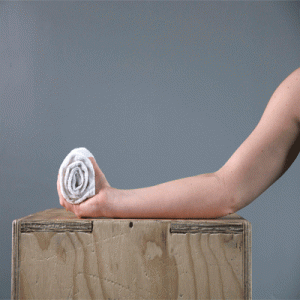 Image source: Amy Crandall[/caption]
[big](Equipment: a small face towel rolled up or a small ball)[/big]
Image source: Amy Crandall[/caption]
[big](Equipment: a small face towel rolled up or a small ball)[/big]
Weak grip is a common symptom of a strained hand.
Strengthening the arm muscles can significantly help in performing our daily tasks. The exercise helps the flexor tendons of the fingers and thumb. Sit at a table with your forearm resting on the table. Hold a rolled towel or a small ball in your hand. Squeeze the towel in your hand and hold it for 10 seconds. Release and repeat 10 times. Switch and do the other hand.- [big]Dumbbell Supination[/big]
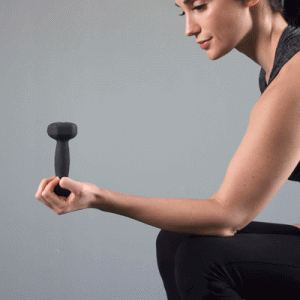 [big](Equipment: a 2 kg dumbbell or a glass bottle)[/big]
The Supinator muscle in the arm is a large forearm muscle that attaches to the elbow. It is responsible for moving the palm upwards and is often involved in movements that can cause tennis elbow.
Sit in a chair holding a 2 kg dumbbell vertically in your hand with your elbow resting on your knee.
Allow the weight of the dumbbell to assist the rotation of the forearm outwards, turning the palm upwards.
Rotate the hand in the other direction until your palm is facing downwards.
Repeat 20 times on each side.
Try to isolate the movement to your lower hand, keeping your arm and elbow still.
[big](Equipment: a 2 kg dumbbell or a glass bottle)[/big]
The Supinator muscle in the arm is a large forearm muscle that attaches to the elbow. It is responsible for moving the palm upwards and is often involved in movements that can cause tennis elbow.
Sit in a chair holding a 2 kg dumbbell vertically in your hand with your elbow resting on your knee.
Allow the weight of the dumbbell to assist the rotation of the forearm outwards, turning the palm upwards.
Rotate the hand in the other direction until your palm is facing downwards.
Repeat 20 times on each side.
Try to isolate the movement to your lower hand, keeping your arm and elbow still.
- [big]Wrist extension[/big]
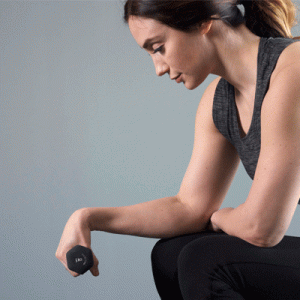 Image source: Amy Crandall[/caption]
[big](Equipment: a 2 kg dumbbell or a glass bottle)[/big]
The wrist extensor muscles are a group of muscles responsible for flexing the wrist, helping with the simplest movements such as signaling stop with our palm, which is why it is essential to exercise them. These small muscles connected to the elbow are often overused, especially during racquet sports.
Sit in a chair holding a 2 kg dumbbell in your hand with your palm facing down, resting your elbow comfortably on your knee.
Keeping your palm facing down, extend your wrist by turning it towards your body. If this is too difficult, then perform the movement without weight.
Return to the starting position and repeat 10 times on each side.
Try to isolate the movement to the wrist, keeping the rest of the arm still.
Image source: Amy Crandall[/caption]
[big](Equipment: a 2 kg dumbbell or a glass bottle)[/big]
The wrist extensor muscles are a group of muscles responsible for flexing the wrist, helping with the simplest movements such as signaling stop with our palm, which is why it is essential to exercise them. These small muscles connected to the elbow are often overused, especially during racquet sports.
Sit in a chair holding a 2 kg dumbbell in your hand with your palm facing down, resting your elbow comfortably on your knee.
Keeping your palm facing down, extend your wrist by turning it towards your body. If this is too difficult, then perform the movement without weight.
Return to the starting position and repeat 10 times on each side.
Try to isolate the movement to the wrist, keeping the rest of the arm still.
- [big]Wrist flexion[/big]
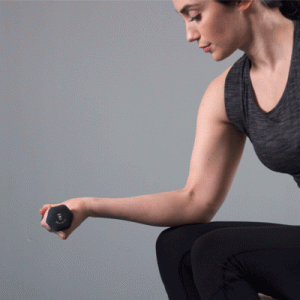 Image source: Amy Crandall[/caption]
[big](Equipment: a 2 kg dumbbell)[/big]
The wrist flexor muscles are the group of muscles that "work" opposite to the extensor muscles. These small muscles connected to the elbow are also subjected to overuse, leading to pain and inflammation.
Sit in a chair holding a 2 kg dumbbell with your palm facing upwards and your elbow comfortably resting on your knee.
Keeping your palm facing upwards, relax your wrist by bending it towards your body.
Return to the starting position and repeat 10 times on each side.
Try to isolate the movement to the wrist, keeping the rest of the arm still.
[big]Towel Twist[/big]
[caption id="attachment_3200" align="alignnone" width="300"]
Image source: Amy Crandall[/caption]
[big](Equipment: a 2 kg dumbbell)[/big]
The wrist flexor muscles are the group of muscles that "work" opposite to the extensor muscles. These small muscles connected to the elbow are also subjected to overuse, leading to pain and inflammation.
Sit in a chair holding a 2 kg dumbbell with your palm facing upwards and your elbow comfortably resting on your knee.
Keeping your palm facing upwards, relax your wrist by bending it towards your body.
Return to the starting position and repeat 10 times on each side.
Try to isolate the movement to the wrist, keeping the rest of the arm still.
[big]Towel Twist[/big]
[caption id="attachment_3200" align="alignnone" width="300"]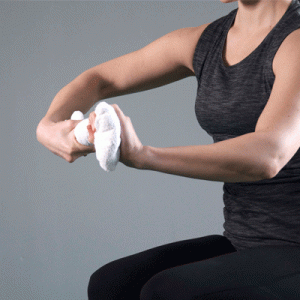 Image source: Amy Crandall[/caption]
[big](Equipment: a small face towel)[/big]
This exercise simultaneously works both muscle groups of the extensors and flexors.
Sit in a chair holding a towel with both hands and relaxed shoulders.
Twist the towel with both hands in opposite directions as if wringing water.
Repeat 10 times and then repeat another 10 times in the other direction.
Image source: Amy Crandall[/caption]
[big](Equipment: a small face towel)[/big]
This exercise simultaneously works both muscle groups of the extensors and flexors.
Sit in a chair holding a towel with both hands and relaxed shoulders.
Twist the towel with both hands in opposite directions as if wringing water.
Repeat 10 times and then repeat another 10 times in the other direction.
Three protective aids for the... pain trilogy!
Apart from gentle exercises to strengthen our hand, another way of immediate relief for our wrists and elbows is bandaging. Bandaging is the oldest technique for preventing, supporting, and rehabilitating strained muscles and joints, restraining and accelerating the recovery of the strained muscle group. Among the first actions we need to take is to choose the appropriate aid that will ward off all warning symptoms. Christou 1910, wishing to offer an effective solution for pain... in triplicate, has created three protective accessories with a modern design, which can be worn anywhere, reinforcing and supporting our wrist, elbow, and shoulder. So for tendonitis or carpal tunnel syndrome, there are two options depending on the degree to which we want to support our wrist.
- The wrist support with silicone pad resembles a stylish hand accessory, while its silicone pad uniquely relieves the joint, massaging and enhancing good blood circulation. The correct closure of the wrist support with the adjustable Velcro keeps the wrist stable without constricting it.
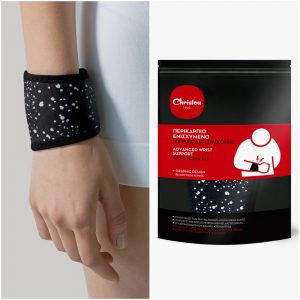 Approx. €5.95 SHOP
- For double reinforcement, the wrist glove relieves the tired or injured wrist and provides all the support and stability it needs, without heating or "constricting" the hand. The advanced airprene material allows the skin to breathe, while the 2 adjustable Velcro straps fit... like a glove on every hand, offering 100% freedom of movement! At the same time, the wrist bandage creates local hyperemia, helping to reduce pain and accelerate the restoration of movement.
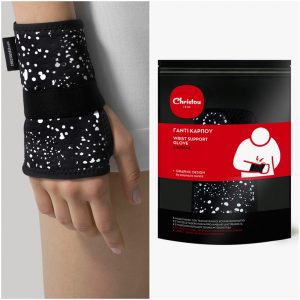 Approx. €6.50 SHOP
- For epicondylitis and intense elbow pain, the silicone elbow pad & compression sleeve, worn together or separately, are the most comprehensive solution for faster recovery of the inflamed area. The elbow pad with the silicone cushion creates a protective layer under the elbow, while also providing micro-massage to the joint, helping to treat and prevent swelling. The compression sleeve, with appropriate pressure, activates good blood circulation, warming up the muscles, thus preventing injuries and accelerating recovery.
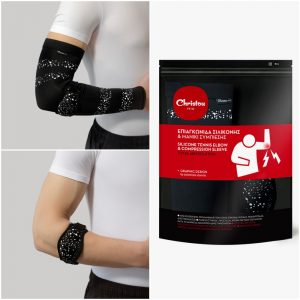 Approx. €11.85 SHOP
For these three common discomforts that make our daily lives more difficult, bandaging is the most natural and effective way of prevention/treatment. Pain is toxic, it spoils our mood and restricts us. Introduce your body to the power of #Christou1910 protective bandaging accessories and keep doing what you always did business as usual!
Approx. €11.85 SHOP
For these three common discomforts that make our daily lives more difficult, bandaging is the most natural and effective way of prevention/treatment. Pain is toxic, it spoils our mood and restricts us. Introduce your body to the power of #Christou1910 protective bandaging accessories and keep doing what you always did business as usual!